Why a driveway is the highest-stakes flatwork job
A driveway carries vehicle loads and the largest continuous slab on most properties, which is why it drives the highest-ticket flatwork installs: typically $8 to $18 per square foot, or roughly $6,000 for a standard two-car drive. It's also the flatwork most exposed to Colorado Springs' freeze-thaw cycling, since it's rarely shaded and takes the brunt of winter deicing and plow traffic.
The spec this climate requires, and why it's a three-driver problem here
The mix-strength, thickness, and joint-spacing numbers below follow the same freeze-thaw-conditioned logic explained on why concrete fails in Colorado Springs: a 4,000-psi air-entrained mix instead of a mild-climate 3,000–3,500 psi, and 5–6 inches of thickness instead of the bare 4-inch minimum, both triggered by the metro's roughly 160 annual freeze days. What's specific to a driveway rather than the general climate spec is the base condition underneath it, and that's where Colorado Springs diverges from a single-driver freeze-thaw market. A driveway's footprint is large enough to cross from stable arkosic sand onto a shallow claystone-bedrock or smectitic-clay pocket within the same slab, so the base prep call isn't uniform across the pour the way it would be on a purely freeze-thaw subgrade: compacting to about 95% standard Proctor density and placing a compacted crushed-stone base matters everywhere, but where heaving and settlement flags a shallow bedrock or clay signal on a specific lot, that section needs the same separation treatment an expansive-clay market would use, layered on top of the freeze-thaw spec rather than swapped in for it. Reinforcement follows the standard mesh-for-shrinkage/rebar-for-load split, with no Colorado Springs-specific variation.
Why jointing matters more here
Control joints pre-place where the slab will crack as it shrinks, at the same 24–36×-thickness spacing covered on why concrete fails in Colorado Springs. What's worth flagging for a driveway specifically: contractors commonly work the tighter end of that spacing (roughly 8 to 10 ft) because a driveway is exposed to thermal cycling on all sides. That's a real concern on a slab that sees 160 freeze days a year, and doubly so where a joint sits over the bedrock-heave zone this metro's western side carries, since a poorly placed joint there gives the ground movement a second place to fault the slab.
The right-of-way apron
The apron, the section of driveway that crosses the public sidewalk or parkway strip into the right-of-way, is frequently governed separately from the rest of the job: a right-of-way or encroachment permit before work starts, a thicker apron section (often 6 to 8 in) with continuous rebar, inspection before and after the pour, and stamped or colored finishes often prohibited in that strip. These are generic patterns seen across many municipalities, not a citation of Colorado Springs' exact rule. Confirm the specific requirement with the city or county public-works department before scoping an apron replacement.
New pour vs. replacement
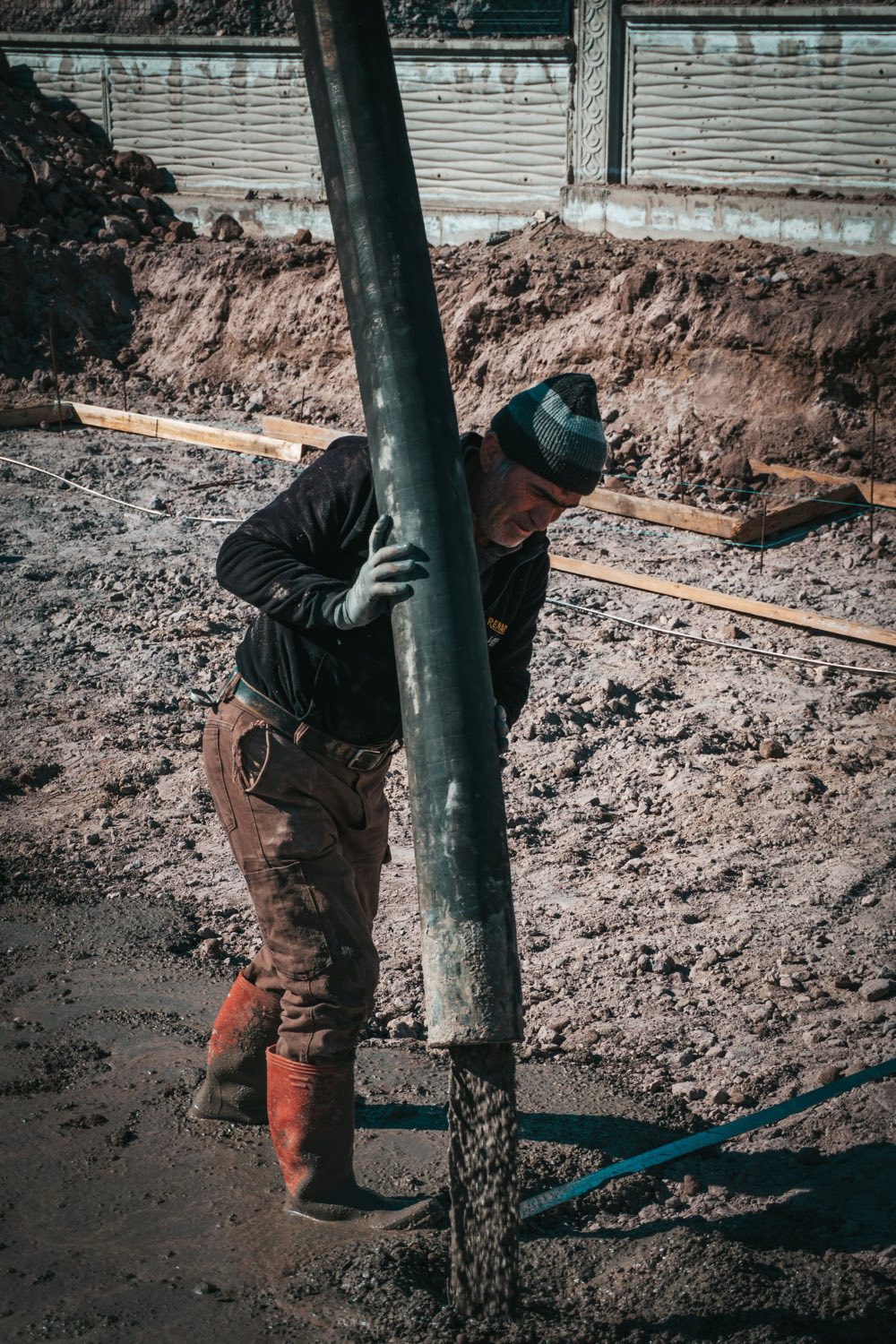
A new pour on an undeveloped or newly demoed area follows base prep, forming, reinforcement, the pour itself, finishing, joint cutting, and cure. Replacement is the same process after demo and haul-off of the old slab. It's the right call once a driveway is heaved, faulted, spalled through, or structurally cracked, since replacement is the only method that resets a failed slab and the only one that removes a crack entirely. On a driveway that's failed from freeze-thaw scaling or from ground movement, replacement is also the point to correct the base, drainage, and mix spec that let the original slab fail.
Cure timeline, and what it costs
Cure-strength timing and installed cost follow the same industry figures as any driveway pour. See concrete patio & slab for the cure-timeline detail and why concrete fails in Colorado Springs for how cold-weather placement here (common through the freeze season) pushes those windows out. Installs typically run $8 to $18 per square foot, with a standard two-car driveway landing around $6,000. That's a typical range, not a quote; base/drainage correction for the bedrock-heave zone is the line item most likely to move a Colorado Springs number away from that baseline.
The question specific to this metro
My neighborhood isn't on the mapped bedrock-heave zone, so do I still need the freeze-thaw spec, or just a standard mix? Yes, still the freeze-thaw spec. The 4,000-psi/air-entrained mix and 5–6-inch thickness are triggered by the metro's roughly 160 freeze days a year, which apply everywhere in El Paso County regardless of which side of the bedrock-heave line a lot sits on. The heave hazard adds an address-specific base-prep question on top of the climate spec; it doesn't replace it.
Area covered
Colorado Springs, CO and El Paso County, including Monument, Falcon, and Black Forest.